Light you can read by
What an illuminated mirror is actually for, why most bathroom light is in the wrong place, and how NUMA is built. With controls you can try.
Stand at most bathroom mirrors and the light comes from above. A downlight in the ceiling, a bar over the frame. It lights the top of your head very well. Your face it lights as a cliff face: brow shading the eyes, nose shading the lip, chin shading the neck. You lean in, tilt up, and put on colour by guesswork.
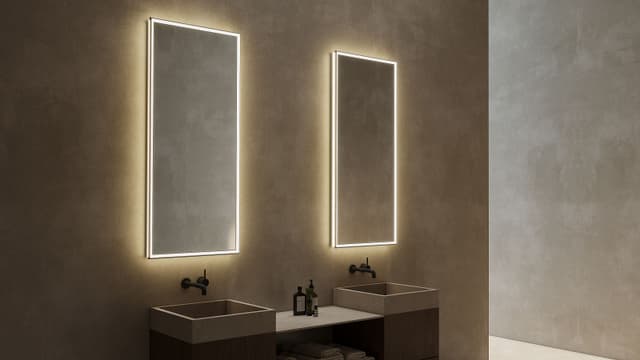
An illuminated mirror moves the light to where the face is: in front of it, at eye height, on both sides. That is the whole idea. Everything else, the colour of the light, how truthfully it renders skin, the glass it reflects from, the parts behind it, is what decides whether the idea works.
Where the light comes from decides what you see
Choose a light source
The face is the same; only the position of the light changes.
Light from the ceiling
The brow, the nose and the chin each cast a shadow downward. Eyes recede, the top lip goes dark, the neck disappears. You tilt your head back to compensate and never quite see the face other people see.
2700, 3000 or 4000 kelvin
Kelvin describes the colour of white light. NUMA runs at three settings, and on tunable models you move between them from the sensor. 3000 K is the all-round bathroom default; 2700 K for a softer evening room; 4000 K where true skin tone matters.
3000 K · warm white
The all-round bathroom default. Warm enough to be kind, neutral enough to judge a colour by.
Tunable NUMA models move between 3000 K and 4000 K; the memory function brings the last setting back. Lumiform tunes 2700 K to 5000 K.
CRI: how honestly the light tells you what colour things are
Sunlight has a colour rendering index of 100. A cheap LED strip scores in the 70s or low 80s and quietly drains reds. NUMA specifies CRI 90 and above across the range, 95 and above on Pro and Lumiform, with an R9 (deep red) value of 50 and above.
Pick a CRI and compare the same four surfaces
Reds collapse toward brown. R9 near zero.
A pure-white mirror, because ordinary glass is green
Ordinary float glass carries iron, and iron reads as a green cast that deepens with thickness. In a mirror it sits between you and the reflection, and it sits under the light. NUMA uses 6 mm low-iron European mirror glass: the iron is taken out at the melt, so the colour the light renders is the colour the glass returns.
Front, back, edge and night: switch the layers on
A NUMA mirror can carry up to four light sources, each doing a different job. F+W Model 3 gives you all of them at once.
Try them in any combination.
Front light lights the face.
Made to the wall, up to twelve feet
Every NUMA mirror is cut to the drawing. F+W runs to 3,660 mm tall, floor to ceiling in a double-height vanity; Lumiform to 3,050 by 3,660 mm.
Pick a height and see it against a person of 1,750 mm.
1,800 mm · a double vanity
Two people, one continuous band of light. The most common NUMA commission.
The parts you never see decide how long it lasts
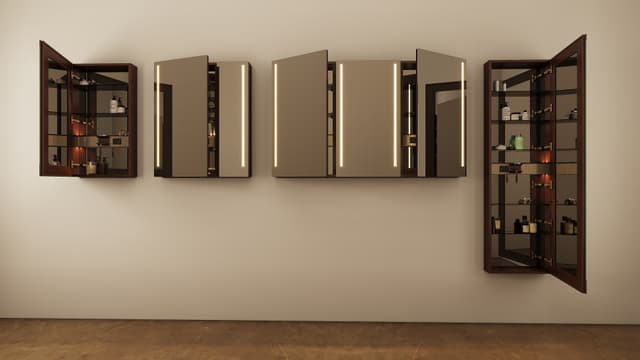
A bathroom is a wet room with a heater in it. The LEDs, the driver and every connector live in that. NUMA is built on a driver-controlled system rather than bare strips: an IP67-rated external driver with colour-coded connectors, IP67 back and edge LEDs behind an acrylic diffuser, IP20 front LEDs sealed inside the body at 110 lumens per watt. Powder-coated aluminium body, rust-resistant steel frame, a heated defogger pad, touch or wave sensor, and a memory of the last setting.
Switching a wave sensor and watching a wall wash come alive teaches more than any page. — NUMA training module