Cloth held in glass
Fabric laminated glass: real textile sealed between two panes. Why a room wants to be seen through and not into, which weaves do what, and how far a custom cloth can go.
A curtain and a wall are the two ways a room has always drawn a line. The curtain lets light through and stops the eye; the wall stops both. Between them is a gap that clear glass does not fill. Clear glass draws no line at all.
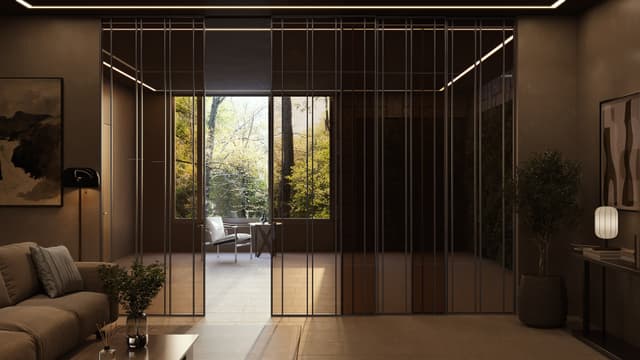
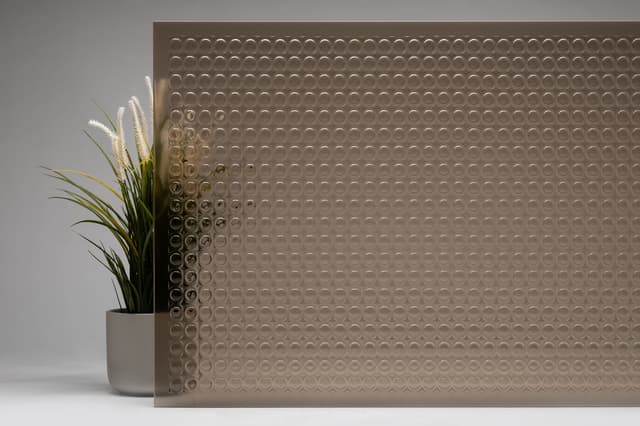
Fabric laminated glass sits in that gap. A length of real cloth is laid between two sheets of glass and the three are bonded under heat and pressure into one solid panel. Light comes through the weave. The view does not. The cloth cannot fade, fray, catch dust or be touched, because it is inside the glass. And if the panel is ever broken, the interlayer holds the pieces where they are.
How much of the next room do you want?
Choose a glass and watch what happens to the person on the other side of it.
Sheer fabric laminate
A fine open weave. Light and movement come through as a soft presence; detail does not.
Glass, cloth, glass, bonded into one sheet
Laminated glass is a sandwich. Two sheets of glass around an interlayer, pressed under heat until the stack becomes one solid panel. With fabric the build is 4 mm + fabric + 4 mm; with woven metal mesh, 5 mm + mesh + 5 mm.
Pull the layers apart to see them.
4 mm + fabric + 4 mm
The standard fabric build. Two 4 mm sheets carry a textile interlayer; the panel is thin enough for sliding tracks and hinged doors.
Because the cloth is inside, the outer faces are plain glass: cleaned like any pane, resistant to moisture and cleaning agents. The bonded panel also blocks most UV and takes the edge off sound.
Five families of weave, and what each does to light
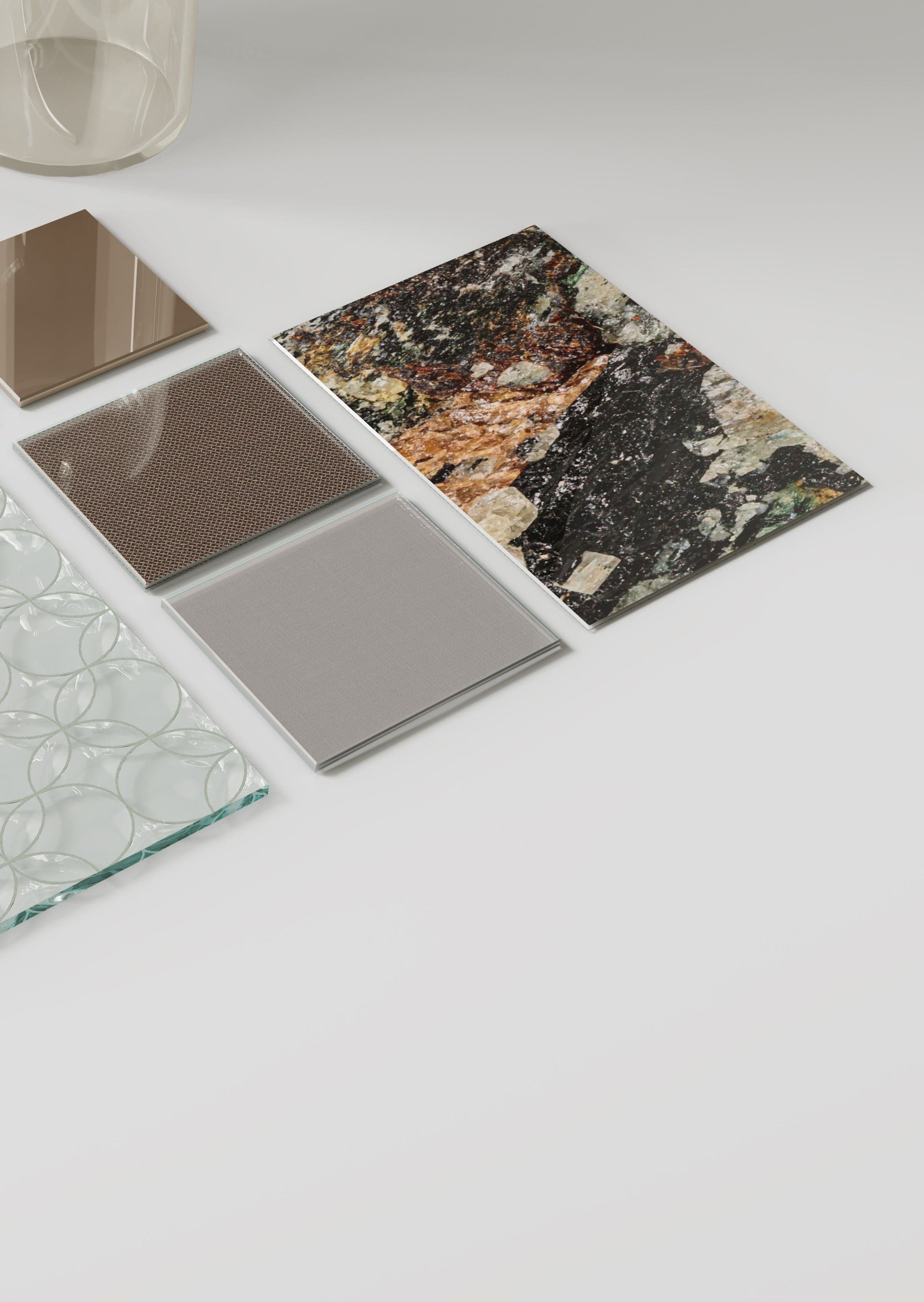
A weave is a decision about how much air is left between the threads. A sheer softens; linen reads as cloth; a closed satin makes a surface; metal mesh makes architecture; a printed cloth makes the panel the artwork.
Choose one to see how it reads in the panel, day and night.
Linen and similar weaves are the everyday privacy glass: a dressing room, an ensuite, a meeting room off an open plan.
What can be chosen, and what can be brought
The interlayer is a decision, not a catalogue page. Colour, weave and pattern are chosen to the project; the panel is cut to the drawing (in SHOJI sliding partitions, to 3,300 mm tall and 750 to 2,100 mm wide); the same cloth can run across a partition, a swing door and a wardrobe face so a suite reads as one material.
Try a tint on a weave
Every NUMAEX system that carries glass can carry cloth
Fabric laminated is one of the six glass families offered on SHOJI sliding partitions, and fabric glass and mesh glass sit on the specification sheets of the swing partition, panel door and Paloma systems. As a NUMARTIS surface it clads feature walls and the faces of ODETTE flush doors, backlit as a Luminous wall where the brief wants a glow.
- Build-up, fabric: 4 mm glass + fabric interlayer + 4 mm glass
- Build-up, metal mesh: 5 mm glass + woven mesh + 5 mm glass
- Outer glass clear or low-iron; toughened to EN 12150 where the system requires
- Plain glass faces: resistant to moisture and cleaning agents; the cloth is never touched